New Life
Posted: July 26th, 2012, 12:08 pm
Hello. I’m Milkhin Sergei, IT engineer from Tomsk, Russia.
The proposed rules I developed in 1989, but their pre-history began even earlier.
In 1975, an article by an engineer-physicist I.Sidorov was published in the third
issue of the Russian popular science magazine "Science and Life".
Trying to develop a Conway's Game of Life, he added a third state for the newly
born cells. Now the cell can be in three states:
0 - empty
1 - young
2 - old
A "young" cell does not die under any circumstances, and it becomes "old" in the next generation.
Fully all the rules I.Sidorov formulated as follows:
1) A young cells in one generation does not die either from overcrowding or loneliness.
A young cell becomes old in the next generation.
2) A new (young) cell is born In each empty cell if the cell had three neighbors
(both old and young cells can be the neighbors).
3) An old cell dies from overcrowding if it borders on four (or more) old cells
or if it shares borders with three (or more) cells, among which there is one young cell at least.
4) The old cell dies of loneliness if it is isolated or has only one neighbor
(both old and young cells can be a neighbor).
It was found, After the simulation of cellular automata according to the rules I.Sidorov,
that at some point the population loses the structure and is growing rapidly.
As it was not interesting to watch this process, I got to develop my own laws of life and death .
.
The following rules were established After selecting the various options:
This rule is left unchanged:
1) A young cells in one generation does not die either from overcrowding or loneliness.
A young cell becomes old in the next generation.
I added a "natural" correction to the rule of the birth:
2) A young cell is born On an empty cell if it has exactly three neighbors, among which there is two old cells at least.
3) An old cell continues to live (exists) in the next generation if it has two or three neighboring cells,
but the number of young cells among them shouldn’t be more than one.
(there should not be more than one young cell among them.)
The rules can be represented graphically in the form of tables. The axes represent young and old neighbors.
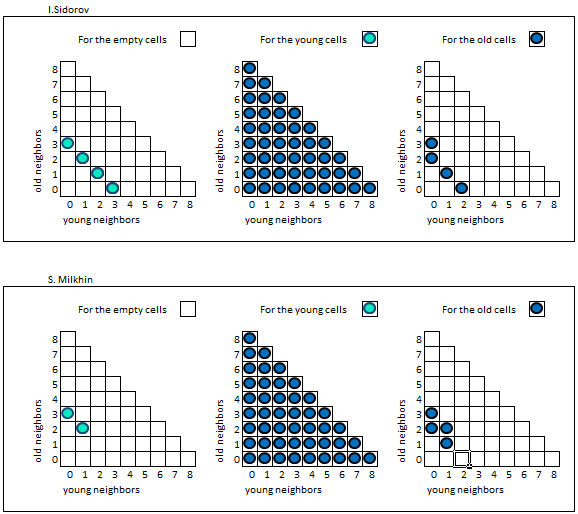
These rules have a number of advantages:
1) Unlimited number of spaceship. I have called them the "Steppers" for a long time
because of the manner of their movement, but later I got to know that there is no
such a word in the English language.
2) There are gliders, they do not almost differ from the gliders of the Conway's Game.
3) A set of stationary patterns is the same as in the Conway's Game.
4) The Patterns of sufficient size will never die. The ships are continually born and die.
It's very interesting to watch this process.
I do not speak English, the text was translated for me from Russian into English I.
So I can not enter into an quick correspondence. It is possible, of cause, to use the google-translator,
but I'm afraid, I was quickly cease to be taken seriously.
In the attachment to the message you can find my rules (MilhinSA.zip) and Sidorov’s ones (SidorovI.zip).
The proposed rules I developed in 1989, but their pre-history began even earlier.
In 1975, an article by an engineer-physicist I.Sidorov was published in the third
issue of the Russian popular science magazine "Science and Life".
Trying to develop a Conway's Game of Life, he added a third state for the newly
born cells. Now the cell can be in three states:
0 - empty
1 - young
2 - old
A "young" cell does not die under any circumstances, and it becomes "old" in the next generation.
Fully all the rules I.Sidorov formulated as follows:
1) A young cells in one generation does not die either from overcrowding or loneliness.
A young cell becomes old in the next generation.
2) A new (young) cell is born In each empty cell if the cell had three neighbors
(both old and young cells can be the neighbors).
3) An old cell dies from overcrowding if it borders on four (or more) old cells
or if it shares borders with three (or more) cells, among which there is one young cell at least.
4) The old cell dies of loneliness if it is isolated or has only one neighbor
(both old and young cells can be a neighbor).
It was found, After the simulation of cellular automata according to the rules I.Sidorov,
that at some point the population loses the structure and is growing rapidly.
As it was not interesting to watch this process, I got to develop my own laws of life and death
. The following rules were established After selecting the various options:
This rule is left unchanged:
1) A young cells in one generation does not die either from overcrowding or loneliness.
A young cell becomes old in the next generation.
I added a "natural" correction to the rule of the birth:
2) A young cell is born On an empty cell if it has exactly three neighbors, among which there is two old cells at least.
3) An old cell continues to live (exists) in the next generation if it has two or three neighboring cells,
but the number of young cells among them shouldn’t be more than one.
(there should not be more than one young cell among them.)
The rules can be represented graphically in the form of tables. The axes represent young and old neighbors.
These rules have a number of advantages:
1) Unlimited number of spaceship. I have called them the "Steppers" for a long time
because of the manner of their movement, but later I got to know that there is no
such a word in the English language
.2) There are gliders, they do not almost differ from the gliders of the Conway's Game.
3) A set of stationary patterns is the same as in the Conway's Game.
4) The Patterns of sufficient size will never die. The ships are continually born and die.
It's very interesting to watch this process.
I do not speak English, the text was translated for me from Russian into English I.
So I can not enter into an quick correspondence. It is possible, of cause, to use the google-translator,
but I'm afraid, I was quickly cease to be taken seriously
.In the attachment to the message you can find my rules (MilhinSA.zip) and Sidorov’s ones (SidorovI.zip).