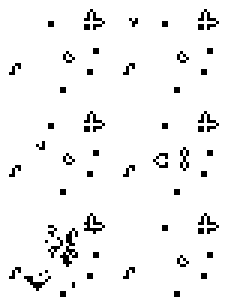
Scorbie wrote: ↑October 30th, 2020, 3:13 am
(Note: I personally use @ for messages not worth pinging another user immediately. I don't mind being pingged though.)
Ah; thank you for explaining.
Scorbie wrote: ↑October 30th, 2020, 3:13 am
The PI at gen 87 (the heptaplet at the center, just in case; It's pretty common too) seems very hard to clean, but one never knows.
I also noticed it, but I don't think that there is enough room for conduits for there to be hope of extracting the ∏. Consequently, something, whether an eater or a catalyst in a conduit, has to interact with the B-heptomino relatively early, before its trailing dust contributes to the ∏'s formation.
By the way, here is another output that is probably useless.
Code: Select all
x = 30, y = 30, rule = B3/S23
15b2o$15bo$13bobo$13b2o9$29bo$28b2o$27b2o$28b2o7$2b2o$bobo16b2o$bo18bobo$2o20bo$5b2o15b2o$6bo$3b3o$3bo!
Edit: There probably isn't a catalyst that works in this case, but this is how easy it is to edgeshoot that R-sexaplet.
Code: Select all
x = 30, y = 28, rule = B3/S23
14bo$12b3o$11bo$11b2o10$29bo$28b2o$27b2o$28b2o7$2b2o$bobo16b2o$bo18bobo$2o20bo$22b2o!
#C [[ T 90 PAUSE 1 ]]
Another edit: I'm trying to find a stable version of Lx73. I haven't found one yet, but I did notice something else.
Code: Select all
x = 31, y = 26, rule = B3/S23
5bo9bo$5b3o5b3o$8bo3bo$7b2o3b2o$b2o$2bo$2bobo$3b2o$30bo$29b2o$2o26b2o$bo27b2o$bobo$2b2o5$3b2o$2bobo16b2o$2bo18bobo$b2o20bo$15b2o6b2o$15bobo$17bo$17b2o!
At generation 114, an octaplet is edgeshot and follows an evolutionary sequence that eventually becomes diagonally symmetric (or at least would if there weren't fishhooks in its way). I'm pretty sure that I've seen that sequence at least twice before in the last few days, it looks edgeshootable, and
it has at least 28 three-glider syntheses, all of which suggest that it should be fairly common. Combined with the fact that there are similarly edgeshootable clusters, some with only seven cells, and the fact that there is a simple way to make it from an R-pentomino, I think that it would be a good cluster to look for conduits accepting. I'll do that after I finish looking for a stable Lx73 unless someone has told me otherwise.
Yet another edit: Here is a way to turn it into a B-heptomino.
Code: Select all
x = 16, y = 10, rule = B3/S23
9bo$7b3o$8bo2$2b2o$bobo$bo10b2o$2o10bobo$14bo$14b2o!
Unfortunately, this particular pair will likely be difficult to hook up to other conduits.
Fourth edit: Why does this not work with an eater 2?
Code: Select all
x = 9, y = 21, rule = B3/S23
6bo$4b3o$3bo$3b2o5$6b2o$6b2o2$2bo$3o$bo4$5b2o$5bobo$7bo$7b2o!
#C [[ PASTEMODE XOR ]]
#C [[ RLE tub bo$obo$bo! ]]
#C [[ PASTET 55 ]]
#C [[ PASTE tub 4 0 ]]
Fifth edit: Is it possible to replace a block with a catalyst that does not get destroyed?
Code: Select all
x = 6, y = 6, rule = B3/S23
4b2o$4b2o2$b2o$2o$bo!
I tried replacing it with a fishhook, and that resulted in another partial R conduit. One can also use a boat or a ship.
Code: Select all
x = 8, y = 8, rule = TripleB3S23
6.2D$5.CE$4.G.G$4.2G2$.2G$2G$.G!
Sixth edit: One can seemingly use anything where the cell closest to the R-pentomino have two neighbors instead of three.
Code: Select all
x = 8, y = 8, rule = TripleB3S23
4.2D$5.D2A$4.G.BC$4.2G.B2$.2G$2G$.G!
Seventh edit: Here is another partial conduit where the block can probably be replaced by a catalyst.
Code: Select all
x = 5, y = 7, rule = B3/S23
b2o$2o$bo3$3b2o$3b2o!
Eighth edit: Apparently,
no one here has thought of a BFx10 before, so now I have another partial conduit that would be new if completed.
MathAndCode wrote: ↑October 23rd, 2020, 5:27 pm
Code: Select all
x = 62, y = 13, rule = B3/S23
2o8b2o8b2o8b2o8b2o8b2o8b2o$2o8b2o8b2o8b2o8b2o8b2o8b2o3$60bo$59b2o$58b2o$59b2o4$5b2o8b2o8b2o8b2o8b2o8b2o$5b2o8b2o8b2o8b2o8b2o8b2o!
Ninth edit: Could this be salvageable?
Code: Select all
x = 31, y = 27, rule = DoubleB3S23
28.C$26.3C$25.C$25.2C6$2C27.2A$.C27.2A$.C.C$2.2C23.2B$27.B$15.2C11.3B$14.2C6.2C6.B$15.C6.C.C$4.2C18.C$5.C18.2C$2.3C$2.C11.2C$14.2C2$17.2C$17.C$18.3C$20.C!
Tenth edit: This partial RF57 looks so promising that I'm already demonstrating that it can be connected to other conduits.
Code: Select all
x = 89, y = 55, rule = LifeHistory
79.2A.A$70.A.2A6.3A$70.2A.A7.A2$79.2A$79.2A16$47.2A$47.A$48.A$47.2A$56.2A$55.A.A$56.A3$44.2A$44.2A$23.2A35.2D21.2A.2A$23.2A34.2D23.A.A$60.D21.A.A.A.A$82.2A3.2A2$57.2D$56.2D$38.A.2A15.D24.A$36.3A.2A40.3A$35.A49.A$36.3A.2A6.2A34.2A$2A36.A.A8.A$2A36.A.A5.3A31.2A$39.A6.A19.2A12.A.A$54.A11.2A14.A$14.2A37.A.A26.2A$14.A38.2A$15.3A$17.A$4.2A$5.A$2.3A$2.A!
Eleventh edit: Here's a quick way to turn an LoM predecessor into a ∏-heptomino.
Code: Select all
x = 11, y = 9, rule = DoubleB3S23
B9.A$3B5.3A$3.B3.A$2.2B3.2A2$4.3C$3.C3.C$3.C$4.C!
It looks like it is probably not compatible with most catalysts, but there might be one or two pairs that work.
I am tentatively considering myself back.