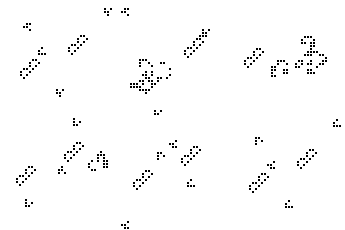
A for awesome wrote:Does anyone know a small predecessor and/or synthesis to [2bo$bobo$o3bo$b4o!]?
It does look like it must crop up all over the place. The way it's made in this soup is an unusual sequence that stays small and in one place for a really long time: prebeehive+tub, then blinker+spark, then broken loaf+preblock, then loaf+blinker, then phi+P sparks, then beehive+preTL.
-- But then it needs some kind of spark on one side to turn it into two copies of 2bo$bobo$o3bo$b4o!, so I'm sure there's a much cheaper way to build it than this:
Code: Select all
x = 66, y = 63, rule = B3/S23
2bo$obo$b2o3$16bo$17bo$15b3o4$34bo$35bo$33b3o4$34bo$34b2o$33bobo4$39bo
$37b2o$38b2o7$38b2o$38bobo$38bo$29b3o$31bo$30bo18$b2o$2b2o$bo3$63b3o$
63bo$64bo!
The sequence I described runs from T=70 to T=100. Without the domino spark on the left, it ends up as two symmetric blinkers. Those blinkers might well be recognizable in a lot of soups, since there are so many small-pattern bottlenecks in this sequence.
... It should be clear from the above that I'm not very good at glider constructions, and so shouldn't really be answering this question -- have never memorized all the common useful sparks. Is that blinker-pair-making object well known among glider-synthesis experts?
EDIT: Odd coincidence, and case in point: the ten-cell polyplet (not really a decomino) that Scorbie asked about yesterday on the Unsure Discoveries thread, if you don't catalyze it with anything, just happens to converge to the end of this sequence that I was going on about -- recognizable final blinkers and all.
Code: Select all
x = 20, y = 27, rule = LifeHistory
6.2A$8.A$5.A2.2A$6.3A$7.A2$16.2D$2D14.D.D$2D16.D$18.2D11$5.D.2D$3.3D.
2D$2.D$3.3D.2D$5.D.D$5.D.D$6.D!
Might it be worthwhile to build a collection of, say, the 100 most common active objects in Catagolue soups at T=100+, or at least the most common dying sparks, and syntheses for them all? I still never know where to go to get various simple "edgy" sparks when I need them, so I always have to go and raid existing syntheses.