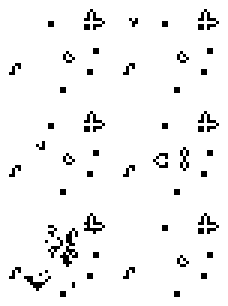
EDIT: The P64 thunderbird hassler "can" support the glider push reaction, if it weren't for the fact that the glider would have interacted with the spark two generations earlier, and that there seems to be no domino sparker that can support it without being destroyed by the glider.
x = 37, y = 37, rule = B3/S23
19b2o$19b2o$11b3o3$16bo3bo$15bo5bo$16bo3bo$11b2o4b3o$11b2o2$27b2o5bo$27b2o5bo$34bo2$6bo23bo$2o3bobo21bobo$2o6bo19bo$8bo19bo$8bo19bo6b2o$5bobo21bobo3b2o$6bo23bo2$2bo$2bo5b2o$2bo5b2o2$24b2o$17b3o4b2o$16bo3bo$15bo5bo$16bo3bo3$23b3o$16b2o$16b2o!
x = 43, y = 15, rule = B3/S23
x = 34, y = 14, rule = B3/S23
25b2o$25b2o$32bo$6bo24bobo$5bobo23bobo$5bobo24bo$6bo2$b2o7b2o$o2bo5bo
2bo11b2o$b2o7b2o11bo2bo$23bobo$7b2o14b2o$7b2o!
Is there any way to synthesize that loaf-like pattern?
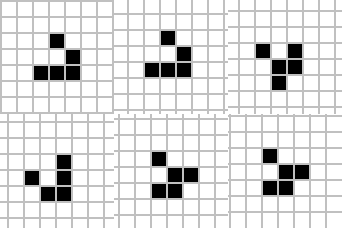
A boat is also a one-glider seed for block-and-glider; you can just remove one cell from the ship, but you have to move the glider over by one lane.
And something that I just noticed this morning is that that boat+glider --> block-and-glider can be triggered by gliders coming from two different directions:
x = 17, y = 36, rule = LifeHistory
7.D$7.2DB$6.2D2B$6.D4B$5.6B$5.5B$5.6B$A4.6B$3A2.7B$3.A.7B$2.A.7B$2.2A.6B$5.7B$5.7B$5.6B2.B$5.B3C2B.B2A$5.3BC4B2A$5.B3C2B.2B$5.6B$5.7B$5.7B$5.6B$6.6B$6.8B2A$4.A9B2A$3.A.A2.9B$3.2A5.7B$10.6B$11.5B$11.6B$11.6B$11.5B$11.2B3D$12.BDB$12.3D$13.B!
x = 43, y = 15, rule = B3/S23
x = 34, y = 14, rule = B3/S23
25b2o$25b2o$32bo$6bo24bobo$5bobo23bobo$5bobo24bo$6bo2$b2o7b2o$o2bo5bo
2bo11b2o$b2o7b2o11bo2bo$23bobo$7b2o14b2o$7b2o!
Is there any way to synthesize that loaf-like pattern?
x = 28, y = 26, rule = B3/S23
18bo$16b3o$15bo$15b2o$24b2o$24b2o2$2b2o$12b2o12b2o$o3bo7b2o12b2o$o4bo
10b2o$2bobobo9b2o$3bobobo16b2o$4bo4bo14b2o$5bo3bo6bo$14bobo7b2o$6b2o6b
3o7b2o4$12b2o$11b2o$3b2o7bo$2bobo$2bo$b2o!
There has already been work on this in the periodic conduits thread.
Sphenocorona wrote: October 28th, 2020, 11:20 pmRegardless, I think this relatively compact form using Karel's p15 should prove that some versions of this reaction *can* be used in periodic conduit circuitry:
Schiaparelliorbust wrote: November 3rd, 2020, 1:13 amHow are they the same reaction? I don't see the resemblance. Sorry if it's obvious.
Look at generation 37 of your pattern. Otismo's pattern appears to have removed objects that are not necessary for the LWSS's creation. However, doing that causes the LWSS to crash into a century instead of escaping, so otismo had to add other objects in order to suppress the junk that would have been suppressed by the objects that otismo removed.
#C [[ STOP 80 ]]
x = 15, y = 22, rule = LifeHistory
9.2C$8.C2.C$9.2C4$9.2C$8.C2.C$9.2C$2C$2C4$5.2C$5.2C3.3A$9.A3.A$8.A5.A
$8.A2.D2.A$8.A5.A$9.A3.A$10.3A!
The blinker from the Beethoven does not appear to be cleanable, though, because there's a cell that interferes with the spot where you'd normally place a fishhook. Interesting, though.
Tanner Jacobi Coldlander, a novel, available in paperback and as an ebook. Now on Amazon.
Kazyan wrote: November 3rd, 2020, 10:26 am
The blinker from the Beethoven does not appear to be cleanable, though, because there's a cell that interferes with the spot where you'd normally place a fishhook.
Use a T-nosed P4 or something like that with a blinker-deleting spark. I think 230P8 would fit there.
wwei23 wrote: November 3rd, 2020, 10:28 amUse a T-nosed P4 or something like that with a blinker-deleting spark. I think 230P8 would fit there.
Yes, but people typically prefer stable catalysts. Sparkers can be useful, but conduits that work at any generation instead of only every 30th step or so are typically preferred (although in this particular case, the exact timing of deleting the blinker doesn't matter).
MathAndCode wrote: November 3rd, 2020, 11:30 amYes, but people typically prefer stable catalysts. Sparkers can be useful, but conduits that work at any generation instead of only every 30th step or so are typically preferred (although in this particular case, the exact timing of deleting the blinker doesn't matter).
A pentadecathalon will probably do, if it fits. 15 is relatively prime with 2, so it has to delete the blinker eventually. I think it would delete the blinker before the conduit could be used again either way.
wwei23 wrote: November 3rd, 2020, 11:36 amA pentadecathalon will probably do, if it fits. 15 is relatively prime with 2, so it has to delete the blinker eventually. I think it would delete the blinker before the conduit could be used again either way.
Unfortunately, the blinker interacts with the pentadecathlon one generation too early.
The side spark of a pentadecathlon does not fit. By moving the non-transparent block down one cell, though, a fumarole (p5; coprime to p2) can be made to work:
#C [[ STOP 80 ]]
x = 18, y = 23, rule = LifeHistory
2A$A2.3A6.2C$.2A8.C2.C$6.A5.2C$6.A$.2A$A2.3A$2A10.2C$11.C2.C$12.2C2$
3.2C$3.2C3$8.2C$8.2C3.3A$12.A3.A$11.A5.A$11.A2.D2.A$11.A5.A$12.A3.A$
13.3A!
I don't know if slparse knows how to make a fumarole, but it should be doable. Taming of the rest of the pattern may come tonight, and hopefully it can move out of Useless Discoveries.
Tanner Jacobi Coldlander, a novel, available in paperback and as an ebook. Now on Amazon.
MathAndCode wrote: November 3rd, 2020, 2:26 pmHere's another useless discovery (that may not be new): An Octagon 2 can cleanly deleted a blinker. ... It's useless because it only works if the blinker is created at that exact time.
Not necessarily useless; it might be possible to use it as part of a P5n mechanism (e.g. like some kind of pre-pulsar shuttle or traffic jam) to remove one side of a forming traffic light. I know there are already some mechanisms that will do that, but it's possible that this might fill a niche somewhere.