For conduit or similar construction purposes, it wouldn't make any difference. For the purpose of automatic synthesis/destruction by (say) an automated constructor like Gemini, it could make a small difference if they had an odd period, as constructor arms might need to alter the recipe slightly for purposes of automatic destruction, and/or construction; e.g. for synthesis, it usually wouldn't matter, but for destruction, you would need to find a glider and/or suite of gliders that would destroy the resulting object, regardless of which phase the griddle was in.Wyirm wrote: ↑January 3rd, 2022, 3:00 pmHypothetically if one were to have an stable conduit with a 100% optimized catalyst that has an exposed area 10 cells long, would using a griddle to optimize population make the conduit a periodic one? even if the periodicity of the griddle itself has no impact on how the conduit functions would it still be a stable conduit?
tl;dr [would a periodic stabalization of a catalyst or conduit that doesn't impact the function of the mechanism still count as stable?]
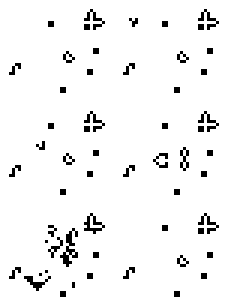
for example: ... the griddle has less population while still leaving the same bounding box, thus making it better than the stable option.
For purposes of enumeration, (e.g. the smallest true period 543 gun), they would not be suitable for odd periods. In any case, as has already been pointed out, this particular case can be avoided by just using two blocks, but it can still matter in other some other situations (e.g. dvgrn's example of two nearby eaters that can only work together as a test tube baby). I have also seen some examples posted on these forums of higher period oscillators whose stators have been reduced in size and/or population by replacing them with small oscillators (like caterers) or similar oscillator fragments.