Difference between revisions of "Cord puller"
Jump to navigation
Jump to search
m (hideimg (pattern shown in the text), reorder) |
|||
| (8 intermediate revisions by 4 users not shown) | |||
| Line 1: | Line 1: | ||
{{ | {{Sawtooth | ||
'''Cord puller''' is a diagonal [[sawtooth]] that was discovered by [[Dean Hickerson]] on May 14, | |name = Cord puller | ||
|pname = cordpuller | |||
|c = 434 | |||
|bx = 98 | |||
|by = 93 | |||
|e = 6 | |||
|discoverer = Dean Hickerson | |||
|discoveryear = 1991 | |||
|rulemin = B3/S23 | |||
|rulemax = B3/S23 | |||
|rulespecial = [[Conway's Game of Life|Conway Life]] | |||
|isorulemin = B3/S23 | |||
|isorulemax = B3/S23 | |||
|plaintext = true | |||
|rle = true | |||
|viewerconfig = #C [[ THUMBSIZE 4 ]] | |||
|hideimg = true | |||
}} | |||
'''Cord puller''' is a diagonal [[sawtooth]] that was discovered by [[Dean Hickerson]] on May 14, {{year|1991}}. It has expansion factor 6. | |||
It works by firing pairs of [[glider]]s at the back of a [[7-engine Cordership]] so that when the first pair hits the Cordership, a [[block]] is created in the path of the following glider pairs. When those pairs hit the block, it is pulled back closer to the [[gun]] at the southeast. When the block reaches the gun, it is destroyed, allowing the gliders to reach the Cordership again and start the process over again. | The pattern can be seen [[#Cord puller|below]]. It works by firing pairs of [[glider]]s at the back of a [[7-engine Cordership]] so that when the first pair hits the Cordership, a [[block]] is created in the path of the following glider pairs. When those pairs hit the block, it is pulled back closer to the [[gun]] at the southeast. When the block reaches the gun, it is destroyed, allowing the gliders to reach the Cordership again and start the process over again. | ||
Its population in generation t = 8(6 | Its population in generation {{nowrap|t {{=}} 8 (6{{sup|n}}) − 216 (n ≥ 2)}} is {{nowrap|t/36 + 558}}, but the population in generation {{nowrap|32 (6{{sup|n}}) − 429 (n ≥ 2)}} is only 469.<ref>[[Alan Hensel]]'s [http://www.ibiblio.org/lifepatterns/ {{filename|lifep.zip}} pattern collection], {{filename|CORDPULL.LIF}}.</ref> | ||
== Cord puller == | |||
{{EmbedViewer | |||
|pname = cordpuller | |||
|viewerconfig = #C [[ THUMBSIZE 2 ZOOM 8 WIDTH 960 HEIGHT 900 ]] | |||
|position = center | |||
|style = width:300px; | |||
}} | |||
==Image gallery== | ==Image gallery== | ||
| Line 11: | Line 37: | ||
|[[Image:Cordpuller_pop.png|thumb|left|The number of alive cells plotted versus the number of elapsed [[generation]]s roughly forms an ever-increasing sawtooth graph.]] | |[[Image:Cordpuller_pop.png|thumb|left|The number of alive cells plotted versus the number of elapsed [[generation]]s roughly forms an ever-increasing sawtooth graph.]] | ||
|} | |} | ||
==References== | ==References== | ||
<references /> | <references /> | ||
[[Category:Patterns involving switch engines]] | |||
Latest revision as of 08:11, 30 April 2023
| Cord puller | |||||||||
| View static image | |||||||||
| Pattern type | Sawtooth | ||||||||
|---|---|---|---|---|---|---|---|---|---|
| Number of cells | 434 | ||||||||
| Bounding box | 98 × 93 | ||||||||
| Expansion factor | 6 | ||||||||
| Discovered by | Dean Hickerson | ||||||||
| Year of discovery | 1991 | ||||||||
| |||||||||
| |||||||||
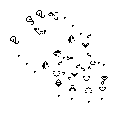
Cord puller is a diagonal sawtooth that was discovered by Dean Hickerson on May 14, 1991. It has expansion factor 6.
The pattern can be seen below. It works by firing pairs of gliders at the back of a 7-engine Cordership so that when the first pair hits the Cordership, a block is created in the path of the following glider pairs. When those pairs hit the block, it is pulled back closer to the gun at the southeast. When the block reaches the gun, it is destroyed, allowing the gliders to reach the Cordership again and start the process over again.
Its population in generation t = 8 (6n) − 216 (n ≥ 2) is t/36 + 558, but the population in generation 32 (6n) − 429 (n ≥ 2) is only 469.[1]
Cord puller
| (click above to open LifeViewer) RLE: here Plaintext: here |
Image gallery
 The number of alive cells plotted versus the number of elapsed generations roughly forms an ever-increasing sawtooth graph. |
References
- ↑ Alan Hensel's lifep.zip pattern collection, CORDPULL.LIF.