Shield bug
| Shield bug | |||||||
| |||||||
| View static image | |||||||
| Pattern type | Spaceship | ||||||
|---|---|---|---|---|---|---|---|
| Number of cells | 3600626 | ||||||
| Bounding box | 934852 × 290482 | ||||||
| Direction | Orthogonal | ||||||
| Period | 240 (mod: 240) | ||||||
| Speed | 31c/240 | 31c/240 | ||||||
| Heat | 2825501.4 | ||||||
| Kinetic symmetry | n | ||||||
| Discovered by | Dave Greene | ||||||
| Year of discovery | 2014 | ||||||
| |||||||
| |||||||

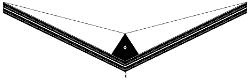
The shield bug is the first and largest 31c/240 orthogonal spaceship, completed by Dave Greene on September 4, 2014.[1] Components for the spaceship were found by Dave and many other contributors, including Kiho Park, Chris Cain, Ivan Fomichev and Adam P. Goucher.
The name is a reference to the large kite-shaped track builder in the middle; during its construction, the entire spaceship was originally thought to result in roughly the same shape when completed.
Design
The frontmost part of the spine houses a primitive track builder, a contraption that makes two more tracks starting from a single pair. It uses seventy-five pairs of gliders that collide to produce either nothing or a kickback reaction to put five gliders on needed lanes, directed forward and to the spaceship's spine. The first three resulting glider streams collide with gliders from a pair crawler to make the outermost chain of blocks and perform two block pulls to put it into its needed place. The last two streams collide with gliders from another pair crawler to make the middle (between the central and outer tracks) chain and perform one pull. The resulting track has perfectly horizontal rows of blocks separated by 114, 108, 88, 108, 114 cells of empty space horizontally. The track builder has 152 Herschel pairs on the central track.
It is immediately followed by a double rake the gliders of which collide with a pair of HWSSes to make a sideways-travelling MWSS that is then used to support the first Herschel pair climber. The resulting slopes of glider and MWSS streams dictate that the width of the spaceship must be above eight times the distance between this rake and the first Herschel pair climber.
After that, follow two identical sets of rakes that do a self-perpetuating slow salvo-based construction of one forwards-travelling HWSS each. The initial target for the slow salvo is made by colliding a glider into one of the HWSSes from the resulting column without destroying it, that makes a beehive and a toad that are completely out of the way of the HWSS column. Using a ten-glider slow salvo, it is transformed into an edge-shooting seed that produces the next HWSS and a block that is cleaned up by the final glider of the set. One set of rakes has 60 Herschel pairs on the central track.
On the tail end of the spaceship is an engineered fuse that uses a different slow salvo to make a sideways-travelling MWSS that is then used to erase the block tracks and is stopped by colliding it into a bi-block on the opposite side. It is the only overtly asymmetrical part of the spaceship, as the rest's two halves are separated by 20 ticks to allow gliders to pass through the middle without colliding with each other, making it asymmetrical too. This 20-tick separation would be conserved in later spaceships based on the 31c/240 Herschel-pair climber. In total, shield bug has 329 Herschel pairs on the central track.
See also
References
- ↑ Dave Greene (September 4, 2014). Re: 31c/240 caterpillar working notes (discussion thread) at the ConwayLife.com forums
External links
- Shield bug at the Life Lexicon
- Patterns
- Spaceships with between 1,000,000 and 9,999,999 cells
- Periodic objects with minimum population between 1,000,000 and 9,999,999
- Patterns with between 1,000,000 and 9,999,999 cells
- Patterns found by Dave Greene
- Patterns found in 2014
- Outer-totalistically endemic patterns
- Spaceships
- Spaceships with period 240
- Orthogonal spaceships
- Spaceships with speed 31c/240
- Spaceships with unsimplified speed 31c/240
- Spaceships with heat between 1,000,000 and 9,999,999
- Spaceships with mod 240
- Spaceships with n symmetry
- Engineered spaceships